The Hollins High School, Accrington
Low-Carbon Heating Retrofit and Energy Efficiency UpgradeVital Synergy partnered with The Hollins High School, an 11–16 secondary academy in Accrington, to deliver a comprehensive sustainable heating retrofit. The project replaced an outdated boiler system with state-of-the-art air source heat pumps and modern controls, dramatically reducing energy use and carbon emissions while improving comfort and compliance. Meticulous design, careful project execution and innovative technology together delivered up to 40% energy savings and modernised the school's heating infrastructure.
Client Overview
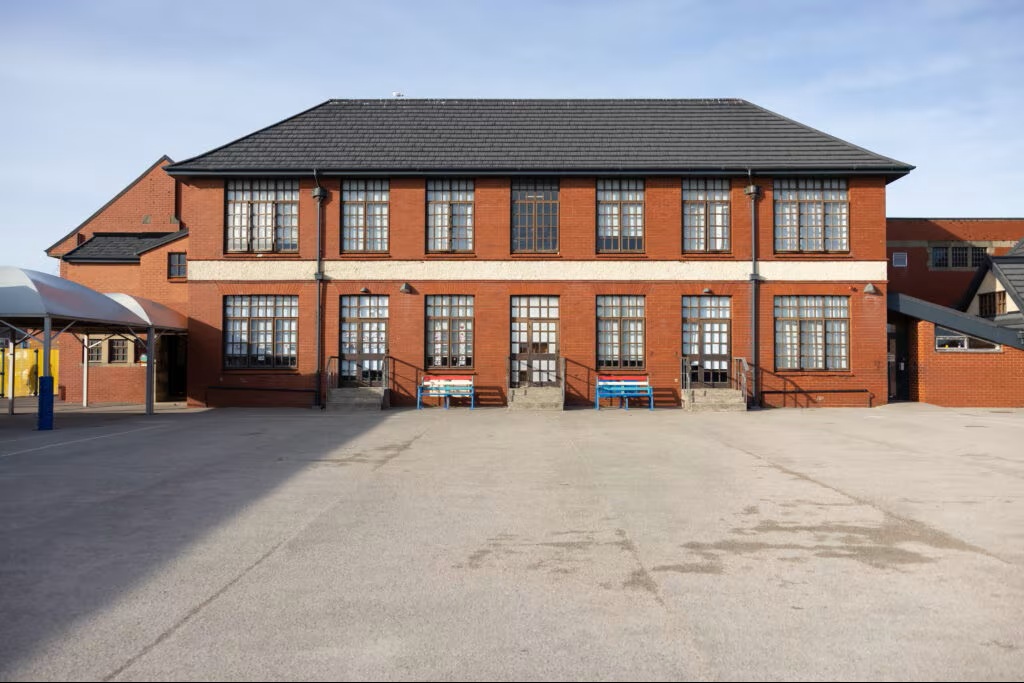
A three-storey, 11–16 secondary academy of approximately 5,500m² in Accrington, Lancashire. The school's existing infrastructure relied on three ageing gas-fired boilers that were inefficient, carbon-intensive and increasingly unreliable, prompting a major decarbonisation and energy efficiency project to upgrade its heating system.
Key project drivers were to replace fossil-fuel heating with a low-carbon solution and future-proof the building, achieve energy efficiency improvements to control rising costs, ensure regulatory compliance with improved EPC ratings and government climate targets, and enhance classroom comfort and heating reliability for students and staff.
A comprehensive on-site survey of the existing heating plant, distribution networks and building fabric mapped each zone's heating requirements. Detailed heat loss calculations and load analysis sized the new equipment precisely, with multiple low-carbon options evaluated for efficiency, capacity, feasibility and long-term sustainability.
Five large Clade air source heat pump units, totalling 960 kW, replaced the gas boilers. Four units met full heating demand while a fifth provided standby redundancy, supplying the building's entire heating needs and contributing to hot water generation.
New insulated distribution piping and low-temperature heat emitters were sized for efficiency. Optimising for lower water temperatures reduced heat losses, maximised the heat pumps' coefficient of performance and improved occupant comfort.
A modern Loxone Building Management System managed heating schedules, thermal zones and heat pump performance, enabling automated setback during unoccupied periods and real-time remote monitoring. Salus smart thermostatic controls allowed local classroom temperature adjustment.
Key Outcomes and Benefits
Five Clade air source heat pumps now supply the school's entire heating demand and contribute to hot water generation, with built-in standby redundancy for resilience.
Annual heating energy consumption was down by up to 40% compared with the old gas-fired system, lowering operational energy costs across the academy.
An estimated 175 tonnes of CO₂ were cut annually by replacing fossil-fuel boilers with low-carbon air source heat pump technology.
The new system delivered consistent, comfortable low-temperature heating across the entire three-storey secondary school.
Four units meet full heating demand year-round, with a fifth providing standby redundancy to safeguard reliability during peak winter loads.
The retrofit improved the school's EPC rating and aligns with Net Zero carbon goals and updated building regulations for the education sector.
Project Detail
What We Delivered
The Hollins High School project was delivered as a structured upgrade programme, beginning with the strip-out of existing heating infrastructure and the installation of new LTHW distribution systems, including modern emitters, upgraded pipework and enhanced insulation to improve efficiency and system performance. The works also incorporated the integration of new controls across all areas, providing improved temperature regulation and consistency throughout the building, while upgrading key services to support the demands of a multi-storey educational environment.
The following phase focused on the optimisation and integration of systems across the site, ensuring full connectivity and improved operational control through upgraded system strategies. All works were delivered within a live school environment, incorporating testing, balancing and commissioning to provide a fully integrated, reliable and energy-efficient heating solution designed to support long-term performance.
Key Benefits
- Improved energy efficiency through the installation of modern heating systems and upgraded distribution infrastructure.
- Enhanced temperature control and consistency across all floors with integrated system controls.
- Increased reliability through the replacement of ageing plant and infrastructure.
- Minimal disruption to operations through delivery within a live school environment.
It was a proud moment to have Vital Synergy come into our school as the MD is a former pupil. It was great to showcase this to the families and students and wider community and the alumni. The new system has helped us reduce our energy costs and help us work towards net zero. Thank you Dave and Team.
Deputy Head, The Hollins High School, Accrington